
Overview
Between March 2 and March 13, 2026, MacPaw shifted its entire operational focus toward a company-wide initiative known as the Agent Practice Sprint. This was not a traditional hackathon but rather a strategic move to embed AI into the daily workflows of every specialist and department, from engineering to legal.
For two weeks, teams stepped away from their usual routines to identify repetitive tasks and replace them with internally-built AI-driven agents. This hands-on approach is the primary driver in the company's push to become an AI-first organization, replacing boring, time-consuming manual routines with reusable automation that speeds up daily processes.
The sprint created a powerful network effect, uniting everyone around a shared effort in working with AI. The scale of the project exceeded internal expectations:
- Around 402 team members participated;
- 355 unique projects were created;
- 247 of these have been completed.
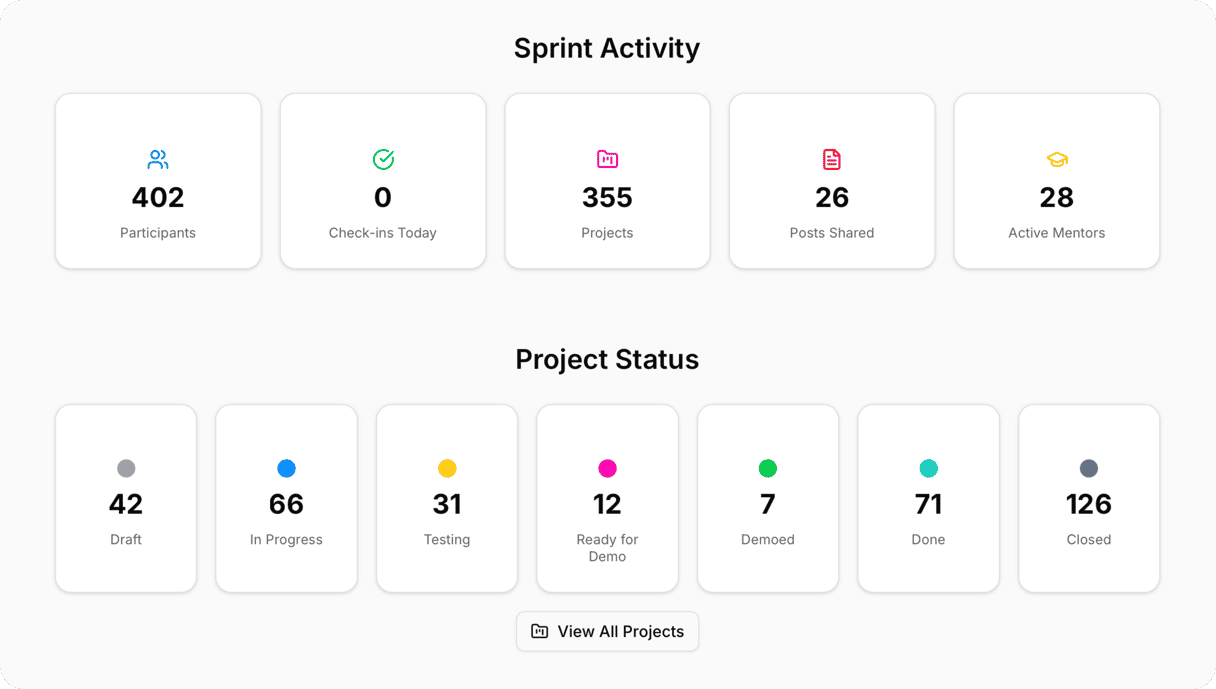
Oleksandr Kosovan, CEO of MacPaw, viewed the sprint as a demonstration of the company's evolution. He noted that seeing engineers, designers, and marketers alike building unique solutions without specific instructions highlighted the vision behind the sprint. "What happened over the last two weeks was not just a hackathon, it was a demonstration of what MacPaw is becoming. AI is the new baseline for how we work, encompassing how we write code, review it, document it, analyze data, serve customers, and manage operations," Oleksandr said.
Organizational Structure
The sprint was designed to enable teams to develop quickly and prioritize practical solutions. Teams worked through a dedicated internal platform where they could register ideas, track progress, and get support from mentors.
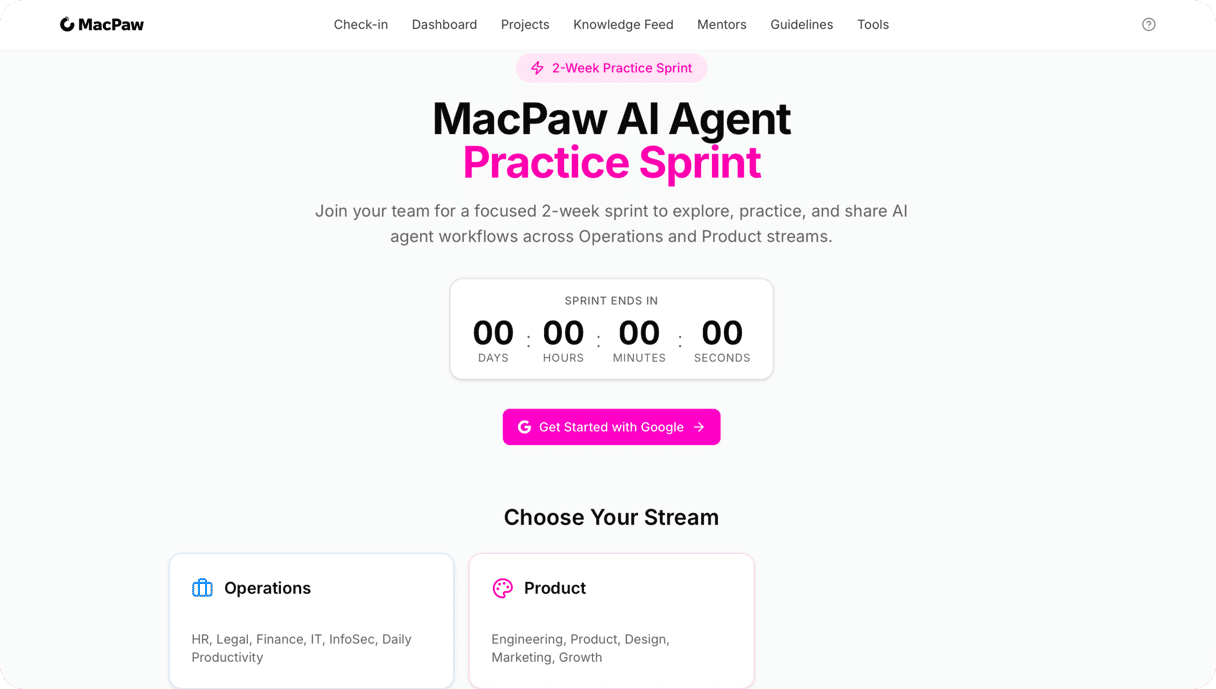
To focus on high-impact use cases, participants were encouraged to identify repetitive tasks and validate their ideas by demonstrating clear “before vs. after” results, measuring time saved, errors reduced, or simplified workflows with their agents.
Progress was shared along the way through a mid-sprint demo, allowing teams to showcase early results, exchange feedback, and iterate quickly. The sprint concluded with a final demo day, which focused on showcasing the most impactful and reusable solutions.
Communication and Support
Slack served as the main communication hub, with dedicated channels for two types of projects: product & daily operations, where people could exchange tips and troubleshoot. Internal experts also held "on-call" hours to provide hands-on help with automation logic. While most of the company focused on the sprint, an "on-duty" team was responsible for maintaining critical company tasks, ensuring that product operations were stable and customers remained supported.
Tools and Infrastructure
MacPaw established a comprehensive technical foundation for the sprint, providing an extensive AI toolkit that allowed all staff to build regardless of their technical background. Teams were able to access systems including Claude (Cowork, Code), Google Gems, n8n, Google Cloud, Cloudflare Pages, GitHub, Cursor, Codex and others in order to create their solutions.
To move beyond surface-level testing, the company also provided API access and lifted standard token limits, a strategic move that encouraged high-volume experimentation across all departments.
To support this, the company provided a one-year subscription to the DataCamp platform, which allowed all team members to take interactive courses and master essential AI and data tools.
"The goal of this sprint was to catalyze the practice of using AI, because only with practice can you really understand how it works,” said Vira Tkachenko, Chief Technology and Innovations Officer. “We achieved this goal because we actually practiced with agents. But this is just the beginning of deploying AI across our organization," stated Vira.
Examples of Agents Built
1. Product and Engineering
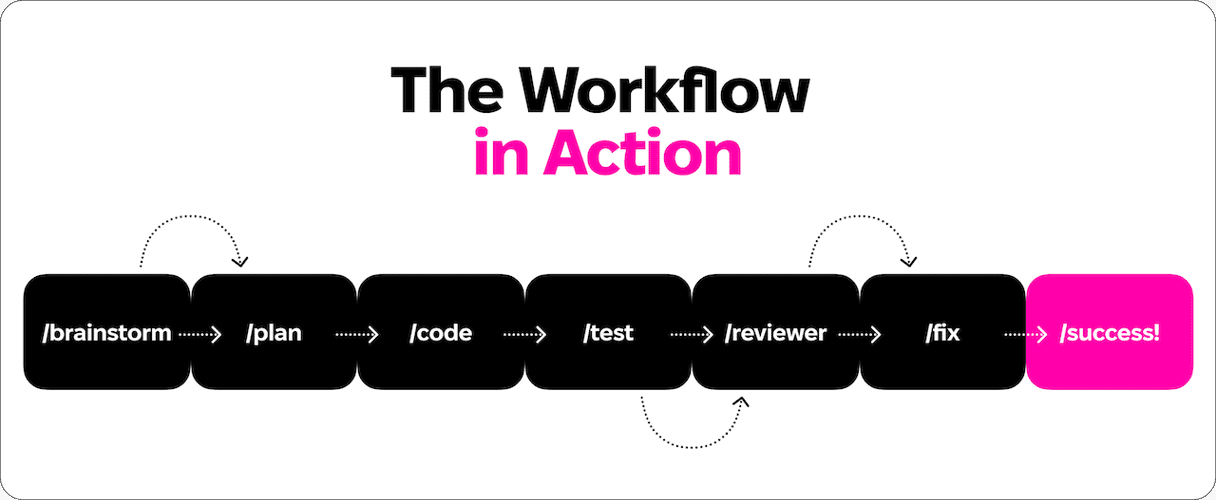
Cloud Quartz Orchestration Toolkit: Yaroslav, a Staff Software Engineer at MacPaw, addressed the frustration of "vibe coding," where developers spend excessive time fixing AI-generated code. To solve this, he built Cloud Quartz, an orchestration system that manages a group of 17 AI specialists, including planners, reviewers, and testers. This system follows a pipeline where one agent’s output is the next agent’s input, ensuring that the final code adheres to best practices and project context with minimal human intervention.
PM-Driven Prototyping: Oleksii, a Senior Product Manager at MacPaw, developed a workflow that allows product managers to create functional prototypes without deep coding knowledge. His agent takes a Jira ticket and generates code directly in an Xcode project, creating a new branch for testing. This enables PMs to validate features and show them to users before committing full development resources, effectively shortening the feedback loop between an idea and a working feature.
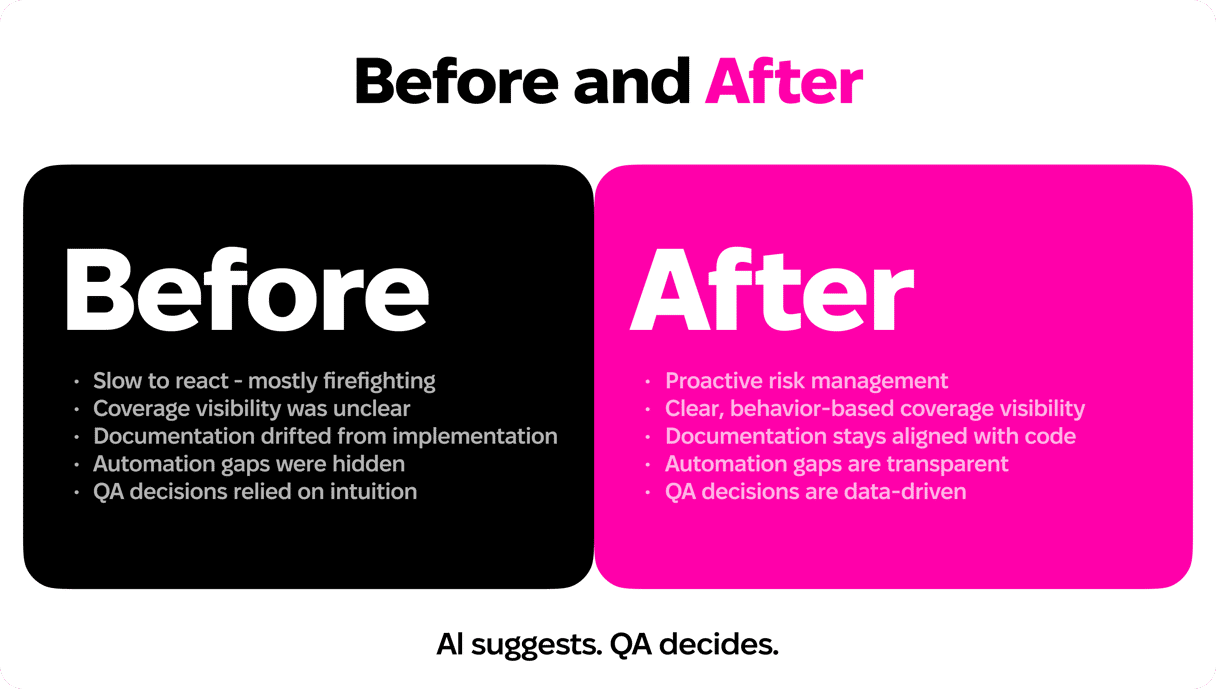
QA Test Documentation: Valeriia, a Senior QA Engineer at MacPaw, addressed the lack of structure in how the QA team handled coverage and automation. Instead of generating tests from raw code, the system provides structured context — including code changes, existing documentation, and a behavior model defined through logic units — and uses prompt templates to guide generation. The model produces draft test updates, which are then validated and reviewed by QA. Once these updates are merged, the system automatically recalculates coverage, maps logic units to manual and automated tests, identifies gaps, and generates an up-to-date coverage report for publication onGitHub Wiki. This system creates a continuous loop (code changes → test documentation → coverage recalculation → visibility on GitHub Wiki), with AI accelerating documentation, while QA ensures correctness.
Threat Intelligence Collector: The Moonlock malware Lab used AI to automate their threat-tracking process. Instead of manually checking various security blogs, the team built an agent that collects publicly available indicators of compromise like file hashes and IP addresses. The AI summarizes the articles and categorizes threats, allowing the security team to develop protection mechanisms much earlier in the threat lifecycle.
Voice of Customer Report: Oleksandr Kosovan, CEO of MacPaw, created a system for the automated analysis of user feedback. The agent retrieves support tickets from Zendesk and calculates key metrics, including ticket trends, version analytics, tag changes, and satisfaction levels. It then passes this data to Gemini for interpretation and generates monthly HTML reports with a dedicated dashboard for each product.
Community Monitor Agent: Another project by Oleksandr Kosovan is a specialized tool for community monitoring. Operating in Google Cloud, the agent tracks brand mentions on Discord and other platforms, analyzes user feedback, and suggests potential responses via Gemini. All responses are sent to a React dashboard, where they can be reviewed and published with a single click.
2. Effective work with documentation and information research
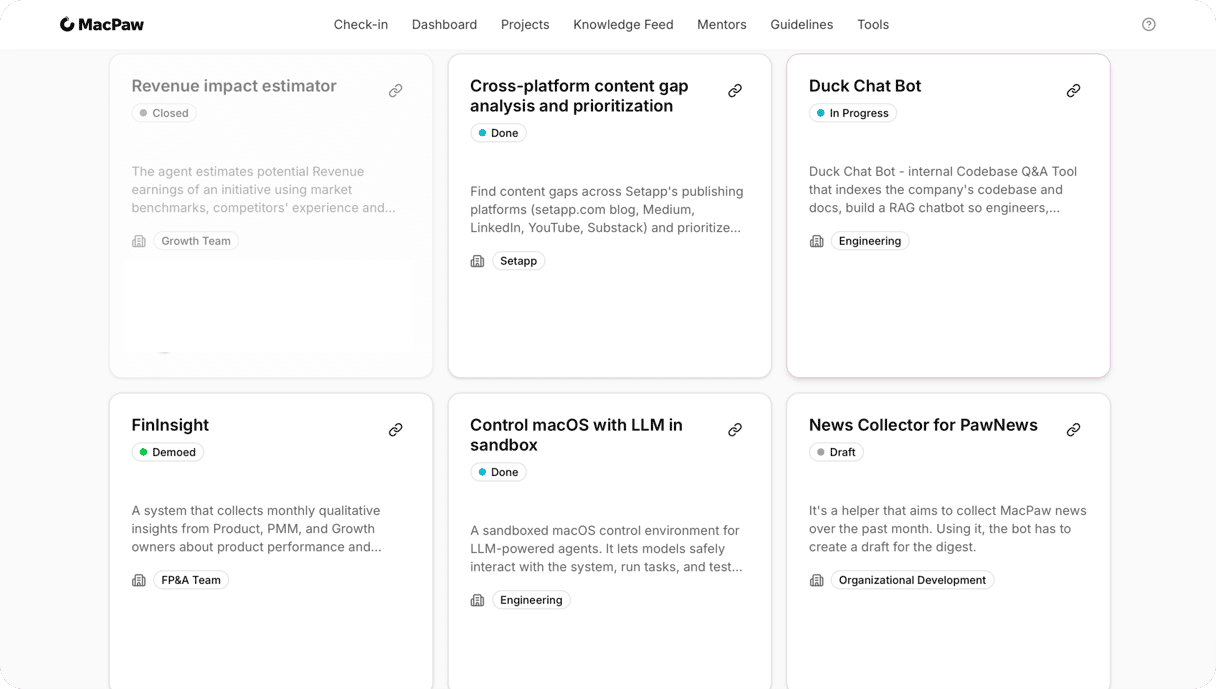
Duck Bot: To solve the bottleneck of information sharing within the company, Kateryna, a Software Engineer at MacPaw, developed Duck Bot. This agent acts as a centralized knowledge base that answers both technical and product questions regarding the MacPaw codebase. By indexing internal information by meaning, engineers and product managers can receive instant answers about the code and product logic, eliminating the need to wait for manual responses from team members.
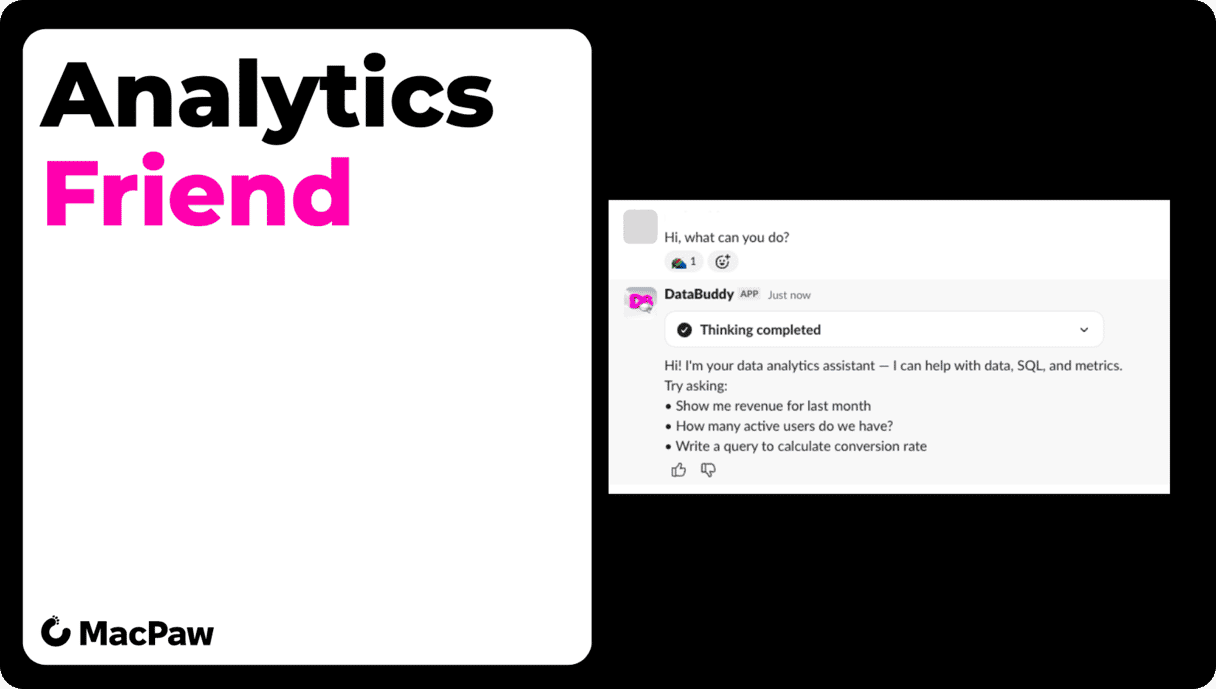
DataBuddy and ML-Ready Data Layer: The data team focused on making MacPaw's data ready for LLMs. They cleaned and documented 40% of the data model to launch DataBuddy, an AI analyst that lives in Slack. It can handle complex research questions, such as analyzing orders or calculating token costs, in about 30 minutes compared to the hours it would take an analyst manually. The tool understands both Ukrainian and English and can generate its own data visualizations and dashboards. To ensure data privacy, access is strictly controlled: the system is available only to analysts and authorized personnel, ensuring that sensitive information remains secure.
Research Intake and Librarian: The R&D team automated their knowledge management process to stay current with academic papers. To accomplish this, they built a Research Digest bot that semantically filters RSS feeds for relevant topics. The agent summarizes papers and allows researchers to save them to their Zotero libraries with one click. This eliminates the manual task of searching and organizing research, keeping the team focused on actual synthesis and analysis.
3. Optimizing finance operations
Revenue Impact Estimator: The growth team developed a tool to quickly evaluate the potential revenue of new ideas. By selecting a product and inputting a hypothesis, the agent analyzes input data, competitor case studies, and industry benchmarks to provide a success score. It generates an executive summary and even suggests risk assessments, allowing managers to prioritize experiments based on data rather than intuition.
FinInsight Narrative Automation: Khrystyna, a Financial Planning and Analysis Manager at MacPaw, identified a gap in financial reporting where raw numbers failed to explain the "why" behind a company's monthly performance. Her FinInsight bot reaches out to budget owners to ask tailored questions about budget variances. The AI then normalizes these responses into executive summaries. This turns scattered comments into a structured knowledge base in BigQuery, making monthly and quarterly business reviews much faster to prepare.
4. Dealing with bottlenecks in everyday work
HR Analytics and Engagement Automation: The HR team automated several time-consuming reporting tasks. They introduced “Pavlik,” an agent that provides key metrics from HiBob and Google Sheets for data-driven decisions. For the annual engagement survey, they replaced weeks of manual PowerPoint creation with a Looker dashboard that uses AI to analyze open-ended feedback and generate actionable summaries for every manager in the company.
Design Clarify and Ticket Auditor: To help designers start their work faster, the team created an AI agent that audits Jira tickets. The agent analyzes a task and automatically generates a structured UX brief on Confluence. It searches for relevant product context, identifies risks and open questions, and attaches useful links from across the organization, ensuring designers have all necessary resources before they even open a design tool.
LegalGate and License Compliance: The legal team moved toward Slack-first communication by launching LegalGate, an automated request pipeline that summarizes legal queries and creates Jira tickets. They also deployed a License Compliance Bot, which allows developers to drop a link to an open-source library in Slack and receive an immediate verdict on whether the license is safe to use, significantly speeding up the release cycle.
Content Gap Analysis: The content team often struggles to keep track of their presence across multiple platforms like Medium, Substack, and YouTube. Alyona, a Content Marketing Manager at MacPaw, created a skill that analyzes the company’s current content library and identifies gaps based on performance data and platform requirements. It generates a prioritized content plan for several months in minutes, ensuring the team stays visible on all relevant channels.
Customer Support Tool: The support team overhauled their current diagnostic tool, which helps troubleshoot app performance issues for users. Previously, updates required manual development work. Now, with AI assistance, the tool is easier to update and allows users to record their screens and send logs directly to the support desk. This reduces the back-and-forth between customers and support agents, solving technical issues much faster.
Brand Compliance Agent: The marketing team often faces delays when ensuring that all copy adheres to brand guidelines. The Setapp team built a brand compliance agent that automatically scores marketing copies against established guidelines before it goes live. This provides immediate feedback and ensures consistency across all platforms without requiring manual review for every small update.
5. Personal productivity
CPOSha Executive Assistant: CPOSha was created to act as a personal assistant for product leadership. The tool provides executive summaries from feedback channels, curates a daily AI news feed based on company strategy, and performs deep research on competitors. It can even score new product ideas against the current MacPaw strategy to identify risks and growth opportunities.
Next steps
The Agent Practice Sprint has marked a fundamental shift in how work is conducted at MacPaw. The results of these two weeks are not viewed as one-time experiments but as the new baseline for operations. The projects built during this time will serve as seeds for future workflows and infrastructure. Over the coming weeks, the ones with real traction will get the support they need to grow into actual workflows or infrastructure.
"If artificial intelligence can triple the productivity of a single person, imagine the growth it can bring when used across an entire organization," comments Oleksandr Kosovan. "However, it is people who, based on their own experience, make decisions and refine the work of these agents. This is why I am optimistic and do not share the view that AI will replace human labor and make many professions obsolete. After all, it is the team that provides the human touch — the indispensable ingredient in any company’s recipe for success."
Moving forward, the company is focusing on a few key priorities:
- Help finish projects that turned out to be more complex and required more time.
- Consolidate similar ideas and fully integrate them into our daily work processes. While all initial projects met the necessary safety standards, moving them into permanent use requires applying even stronger security and maintenance rules to ensure long-term reliability.
- Begin measuring the actual effectiveness of the implemented agents.
- Launch monthly AI Office Hours, an open space for everyone to share experiences, troubleshoot questions, and showcase new developments.
"The sprint turned out to be very intensive. Expectations were modest, but the reality was a pleasant surprise. People embraced the opportunity to optimize their routines," concludes Liliya Mudryk, Chief Organizational Development Officer. "The sprint helped the team realize that interacting with AI is not a threat to their work, but rather a benefit. For the company, this was a real opportunity to expand our internal resources and free up time for what truly matters. We saw that even non-technical specialists can create unique solutions if given the right support and clear tools.”