
Siri has become an essential part of using Apple devices. What started on the iPhone is now built into Macs, helping you search for files, send messages, and answer questions with just your voice. And with Apple Intelligence making Siri even more capable in macOS Tahoe, it's natural to wonder what happens to the information you share with it.
In this guide, we'll explain what data Apple stores, how to delete your Siri history on Mac, and what you can do to better protect your privacy.
Siri privacy settings at a glance
Privacy setting | What it does | Where to find it |
Delete Siri & Dictation History | Removes Siri and Dictation requests Apple has stored during the past six months. | System Settings > Apple Intelligence & Siri (or Siri & Spotlight) |
Improve Siri & Dictation | Stops Apple from using your Siri interactions to help improve Siri and Dictation. | System Settings > Privacy & Security > Analytics & Improvements |
Siri Suggestions | Turns off Siri suggestions in Spotlight and other apps without disabling Siri completely. | System Settings > Siri & Spotlight |

What Siri knows: can you see your Siri history?
Let's take a look at what happens when you ask Siri a question.
Whether you're using your Mac, iPhone, or iPad, if you're signed in with the same Apple Account, Siri works across all your devices. Each device has access to its own files and settings, and your Siri and Dictation data is associated with your Apple Account settings.
When you ask Siri a question, to answer it or fetch the requested files, it can search your files, Mail, calendar events, notes, and even information inside documents if you've allowed it to. It can also search the web whenever needed to answer your request.
There's a reason why Siri doesn't work without an internet connection most of the time. Siri isn't just an assistant that lives on your Mac — many requests are completed by using Apple's servers. With Apple Intelligence in macOS Tahoe, many simple requests are handled directly on your device, while more complex ones may use Apple's Private Cloud Compute to process them securely.
The good news is that Apple says Siri requests aren't directly associated with your Apple Account. Instead, they're linked to a random identifier that changes regularly. If you've chosen to enable Improve Siri & Dictation, Apple may also use transcripts of some interactions to improve Siri and Dictation.
But one thing hasn't changed: users still can't access Siri history to view previous conversations. While Apple stores certain Siri and Dictation data for a limited time, there isn't a Siri history log that you can browse or search through on your Mac.
Instead, Apple lets you delete the Siri & Dictation data associated with your device. And we’ll tell you how to do that.

How to delete Siri history on Mac
As you might have guessed from the previous section, since Siri history isn't stored on your Mac or available for you to browse, there isn't a way to view or edit it.
The good news is that Apple lets you delete the Siri & Dictation data it stores on its servers. Keep in mind that this removes data from the last six months only.
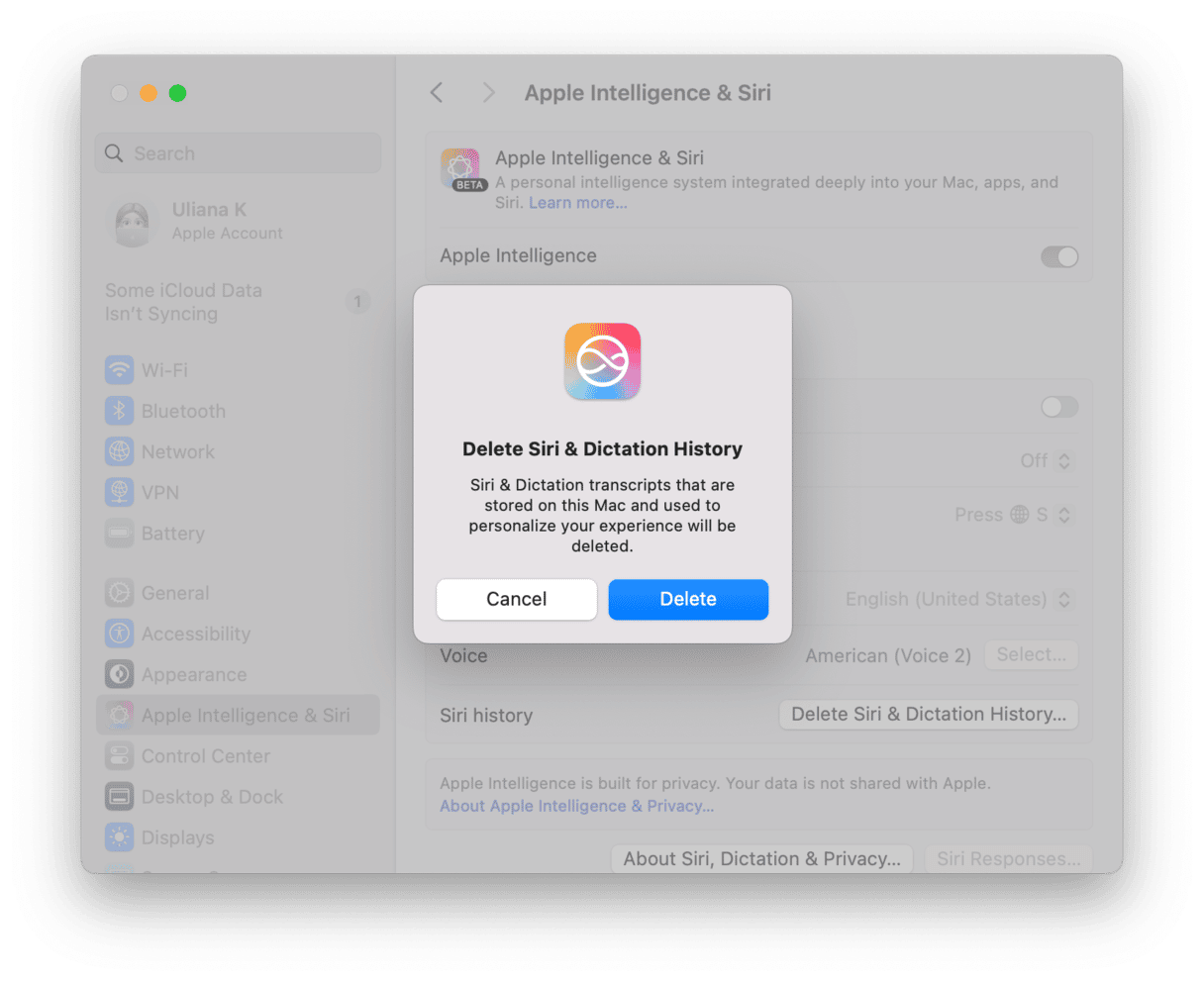
On macOS Tahoe, Sequoia, Sonoma, Ventura, and later
- Open System Settings.
- Click Apple Intelligence & Siri (or Siri & Spotlight, depending on your macOS version).
- Click Delete Siri & Dictation History.
- Click Delete to confirm.
Once you confirm, Apple deletes the Siri and Dictation requests associated with your device that were stored during the previous six months.
On macOS Monterey and earlier
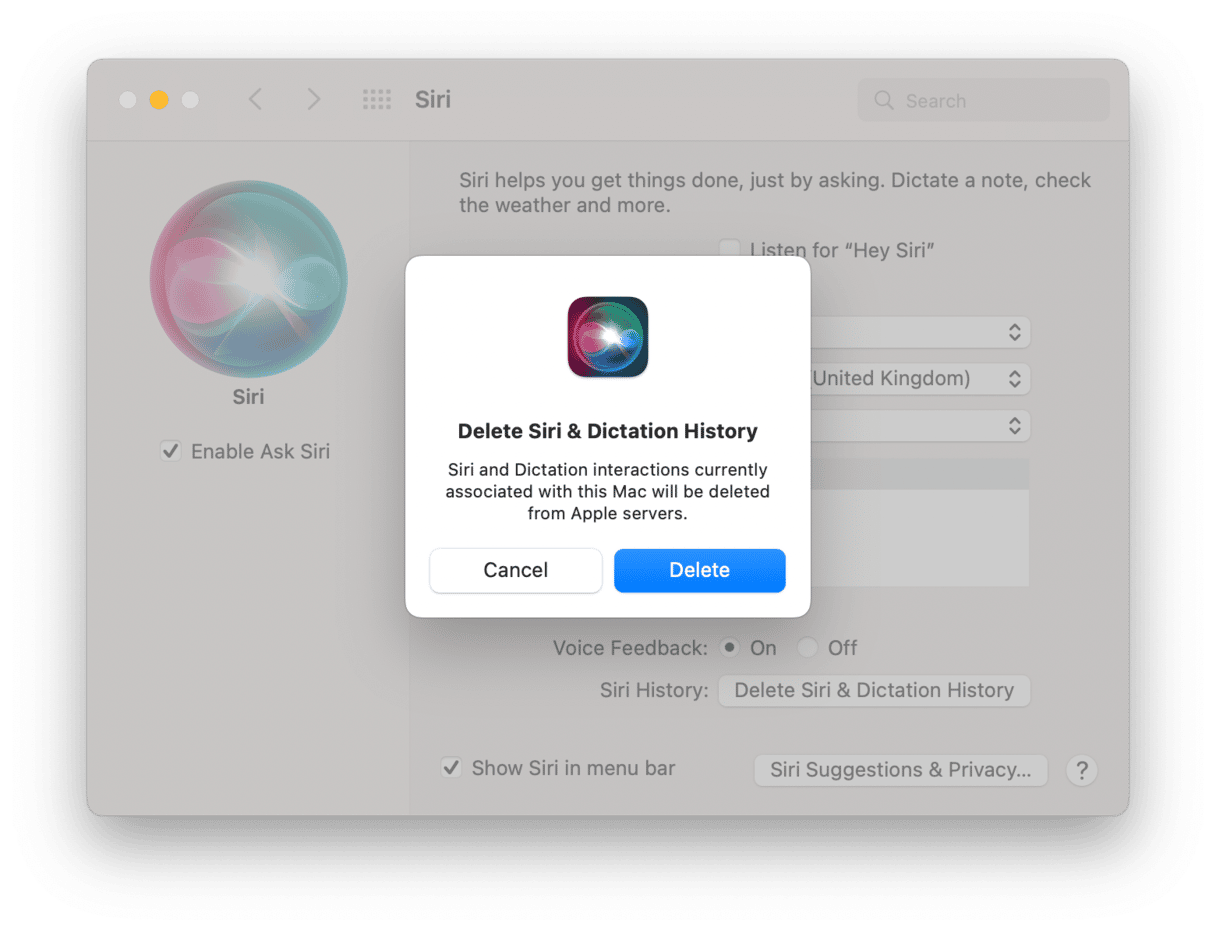
If you're using an older version of macOS:
- Go to System Preferences.
- Click Siri.
- Click Delete Siri & Dictation History.
- Confirm your choice.
Like many Siri features, you'll need to be connected to the internet for the request to be sent to Apple.
What exactly does Apple store — and for how long?
One of the biggest questions users have is what Apple actually keeps after you talk to Siri.
Due to Apple, your Siri requests aren't stored together with your Apple Account. Instead, they're linked to a random device identifier that changes from time to time. This helps Apple analyze Siri requests without directly identifying you.
If you've enabled Improve Siri & Dictation, Apple may also receive transcripts of some Siri interactions to help improve Siri and Dictation. If you prefer not to share this data, you can turn the feature off and continue to use Siri normally.
Another important thing you should know: when you choose Delete Siri & Dictation History, Apple deletes the Siri and Dictation requests it has stored for the previous six months.
This doesn't mean you can view those requests before removing them. Apple doesn't provide users with a Siri history log or conversation history on Mac. The delete option simply removes the stored Siri & Dictation data associated with your device.
How to turn off Improve Siri & Dictation
If you want to keep using Siri but don't want Apple to use your interactions to help improve the service, you don't have to disable Siri completely.
Apple gives you the opportunity to opt out of sharing Siri and Dictation interactions for analysis while still using Siri for your everyday tasks.
Here's how do that:
- Open System Settings.
- Go to Privacy & Security.
- Click Analytics & Improvements.
- Turn off Improve Siri & Dictation.
With this setting disabled, Siri continues to work as usual, but Apple won't use your Siri and Dictation interactions to improve its voice assistant.
Does deleting Siri history also remove Siri Suggestions?
No, these are two separate features.
Deleting your Siri & Dictation History removes the Siri requests Apple stores on its servers, but it doesn't affect Siri Suggestions that appear in Spotlight Search, Search, or other apps on your Mac.
Siri Suggestions are based on your on-device activity, such as the apps you use most often or the people you often contact. They remain available even after you've deleted your Siri & Dictation history.
If you want to stop seeing Siri Suggestions, you can turn them off separately.
To do that:
- Open System Settings.
- Click Siri & Spotlight.
- Scroll down to Siri Suggestions.
- Turn off the suggestions you don't want to see, such as suggestions in Spotlight, Look Up, or individual apps.
You can also turn off Siri Suggestions for specific apps while leaving them enabled everywhere else, giving you more control over what Siri can access and recommend.
Apple Intelligence and Siri in macOS Tahoe
With Apple Intelligence in macOS Tahoe, Siri can understand more natural conversations and deal with more complex requests.
Many requests are processed directly on your Mac, which helps improve both speed and privacy. If a request needs more computing power, Apple uses Private Cloud Compute. According to Apple, information processed through Private Cloud Compute isn't stored after your request is complete.
Even with these changes, the way you manage your Siri data stays the same. You can still delete your Siri & Dictation history, turn off Improve Siri & Dictation, or disable Siri completely if you like.

How to protect your privacy on Mac
If learning how Siri handles your data has you thinking more about privacy, there are several ways to limit what information Siri can access and share.
The most obvious option is to turn Siri off completely:
- Go to System Settings > Apple Intelligence & Siri (or Siri & Spotlight, depending on your macOS version).
- Turn off Ask Siri.
When Siri is disabled, it stops responding to voice commands, processing Siri requests, and communicating with Apple's servers on your behalf.
Limit what Siri can access
You don't necessarily have to turn Siri off to improve your privacy.
If there are certain apps you don't want Siri to use for suggestions or searches, you can manage them individually:
- Open System Settings.
- Go to Siri & Spotlight.
- Scroll down to the list of apps.
- Select an app and turn off Show Content in Search, Learn from this App, or other Siri-related options, depending on the app.
This gives you more control over what Siri can index and suggest without affecting the rest of the feature.
Keep sensitive files private
You can also limit Siri's access to personal information by storing sensitive files securely. If you keep confidential documents, passwords, financial records, or other private data on your Mac, consider using a trusted encrypted vault or secure storage app.
That way, even if Siri searches your Mac for relevant information, those protected files won't be accessible unless you've unlocked them.
How to delete Siri history on iPhone and iPad
If you use Siri across multiple Apple devices, you may also want to delete your Siri & Dictation history on your iPhone or iPad.
Follow these steps:
- Open Settings.
- Tap Apple Intelligence & Siri (or Siri, depending on your iOS version).
- Tap Siri & Dictation History.
- Select Delete Siri & Dictation History.
- Confirm your choice.
If you're signed in with the same Apple Account on all your devices, reviewing your Siri privacy settings on each one is a good idea. That way, you can decide where Siri is allowed to collect data and where you'd rather keep things more private.
While you can't view your Siri history on a Mac, you have control over how Siri handles your data. You can delete the Siri & Dictation history Apple stores, turn off Improve Siri & Dictation to stop sharing interactions for analysis, manage Siri Suggestions separately, or disable Siri if you don't use it.
With Apple Intelligence making Siri more capable than ever, knowing these privacy settings can help you decide how much information you're comfortable sharing while still getting the most out of your Mac.
Frequently asked questions
Can you see your Siri history on Mac?
No, Apple doesn't provide a way to view your Siri history or previous conversations on Mac. Siri & Dictation data may be stored by Apple for a limited time, but there's no history log that users can reach or search.
Does Siri save everything you say?
No, Siri processes your requests to provide answers or complete tasks, but Apple says Siri requests aren't directly associated with your Apple Account. If you've enabled Improve Siri & Dictation, Apple may use transcripts of some interactions to help improve Siri. Otherwise, your requests aren't used for this purpose.
How long does Apple keep Siri's history?
When you choose Delete Siri & Dictation History, Apple deletes the Siri and Dictation requests it has stored during the previous six months. Apple doesn't let users browse this data before it's deleted.
Does deleting Siri history remove Siri Suggestions?
No, Siri Suggestions are stored separately on your Mac and are based on your on-device activity. Deleting Siri & Dictation history doesn't clear them. If you no longer want to see Siri Suggestions, you'll need to turn them off separately in System Settings > Siri & Spotlight.
Can I delete Siri history on my iPhone too?
Yes, you can. On your iPhone or iPad, open Settings > Apple Intelligence & Siri (or Siri) > Siri & Dictation History, then tap Delete Siri & Dictation History. This removes the Siri & Dictation data Apple has stored for your device.