So you need to download old macOS version? Regardless of the reason driving this decision, there are a few different ways to do it: get an installer via the App Store, run a few Terminal commands, or downgrade to an older macOS version after an upgrade (for example, roll back from macOS Golden Gate to macOS Tahoe). We will show you all of these methods below.
A list of all macOS versions
We’ll be repeatedly referring to these Apple OS versions below, so it’s good to know the basic macOS timeline.
| Version | Name | Release date | Minimum supported Mac model year | Direct download link |
| Mac OS X 10.0 | Cheetah | Mar 24, 2001 | 1998 | n/a from Apple |
| Mac OS X 10.1 | Puma | Sep 25, 2001 | 1998 | n/a from Apple |
| Mac OS X 10.2 | Jaguar | Aug 24, 2002 | 1998 | n/a from Apple |
| Mac OS X 10.3 | Panther | Oct 24, 2003 | 1999 | n/a from Apple |
| Mac OS X 10.4 | Tiger | Apr 29, 2005 | 1999 | n/a from Apple |
| Mac OS X 10.5 | Leopard | Oct 26, 2007 | 1999 | n/a from Apple |
| Mac OS X 10.6 | Snow Leopard | Aug 28, 2009 | 2006 | n/a from Apple |
| OS X 10.7 | Lion | Jul 20, 2011 | 2006 | Lion 10.7 |
| OS X 10.8 | Mountain Lion | Jul 25, 2012 | 2007 | Mountain Lion 10.8 |
| OS X 10.9 | Mavericks | Oct 22, 2013 | 2007 | n/a from Apple |
| OS X 10.10 | Yosemite | Oct 16, 2014 | 2007 | Yosemite 10.10 |
| OS X 10.11 | El Capitan | Sep 30, 2015 | 2007 | El Capitan 10.11 |
| macOS 10.12 | Sierra | Sep 20, 2016 | 2009 | Sierra 10.12 |
| macOS 10.13 | High Sierra | Sep 25, 2017 | 2009 | High Sierra 10.13 |
| macOS 10.14 | Mojave | Sep 24, 2018 | 2010 | Mojave 10.14 |
| macOS 10.15 | Catalina | Oct 7, 2019 | 2012 | Catalina 10.15 |
| macOS 11 | Big Sur | Nov 12, 2020 | 2013 | Big Sur 11 |
| macOS 12 | Monterey | Oct 25, 2021 | 2013 | Monterey 12 |
| macOS 13 | Ventura | Oct 24, 2022 | 2017 | Ventura 13 |
| macOS 14 | Sonoma | Sep 26, 2023 | 2018 | Sonoma 14 |
| macOS 15 | Sequoia | Sep 16, 2024 | 2018 | Sequoia 15 |
| macOS 26 | Tahoe | Sep 15, 2025 | 2019 | Upgrade via System Settings |
| macOS 27 | Golden Gate | Sep 14, 2026 | 2020 (Apple silicon only) | Upgrade via System Settings |
How to get old versions of macOS
The process of old macOS download includes several steps. Follow them closely one by one.
Step 1. Prepare your Mac for installation
Given your Mac isn’t new and is filled with data, you will probably need enough free space on your Mac. This includes not just space for the OS itself but also space for other applications and your user data. One more argument is that the free space on your disk translates into virtual memory, so your apps have “fuel” to operate on.
For instance, to install older macOS versions, you will need at least 8 GB of free space. For newer versions, you will need three times more — around 12 GB to download the installer and 12 more GB to install the macOS. Still, it is better to have more (like 40 GB) to ensure a proper upgrade.
Next, you will need enough disk space available, for example, to create a Recovery Partition. Here are some ideas to free up space on your drive:
- Uninstall large unused apps
- Empty Trash Bin and Downloads
- Locate the biggest files on your computer:
Go to Finder > All My Files > Arrange by size
Then, you can move your space hoggers onto an external drive or cloud storage.
If you aren’t comfortable with cleaning the Mac manually, there are some nice automatic “room cleaners.” Our favorite is CleanMyMac, as it’s simple to use and fast. It deletes system junk, old broken apps, and the rest of hidden junk on your drive.
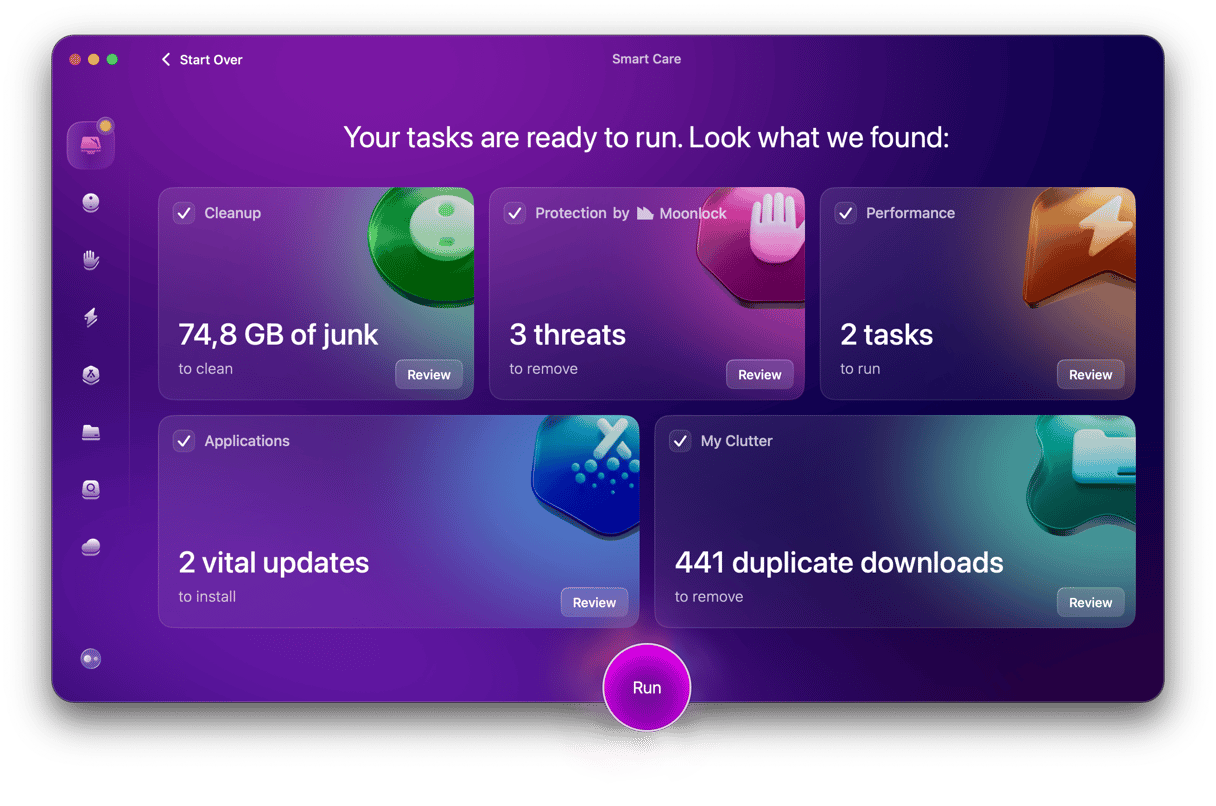
Why use CleanMyMac
- Comes with 25+ tools to clean, maintain, and optimize your MacBook
- Based on internal reports, on average, users reclaim 9 GB of space by removing junk files alone
- According to internal data, cleans over 50K Macs daily
Step 2. Get a copy of macOS download
Normally, it is assumed that updating OS is a one-way road. That’s why going back to a past Apple OS version is problematic. The main challenge is to download the OS installation file itself because your Mac may already be running a newer version. If you succeed in downloading the OS installation, your next step is to create a bootable USB or DVD and then reinstall the OS on your computer.
How to download older macOS versions via the App Store
The easiest way to get an old macOS installer is to download it from the App Store. For now, you can download macOS High Sierra or later. Here are the links to check out:
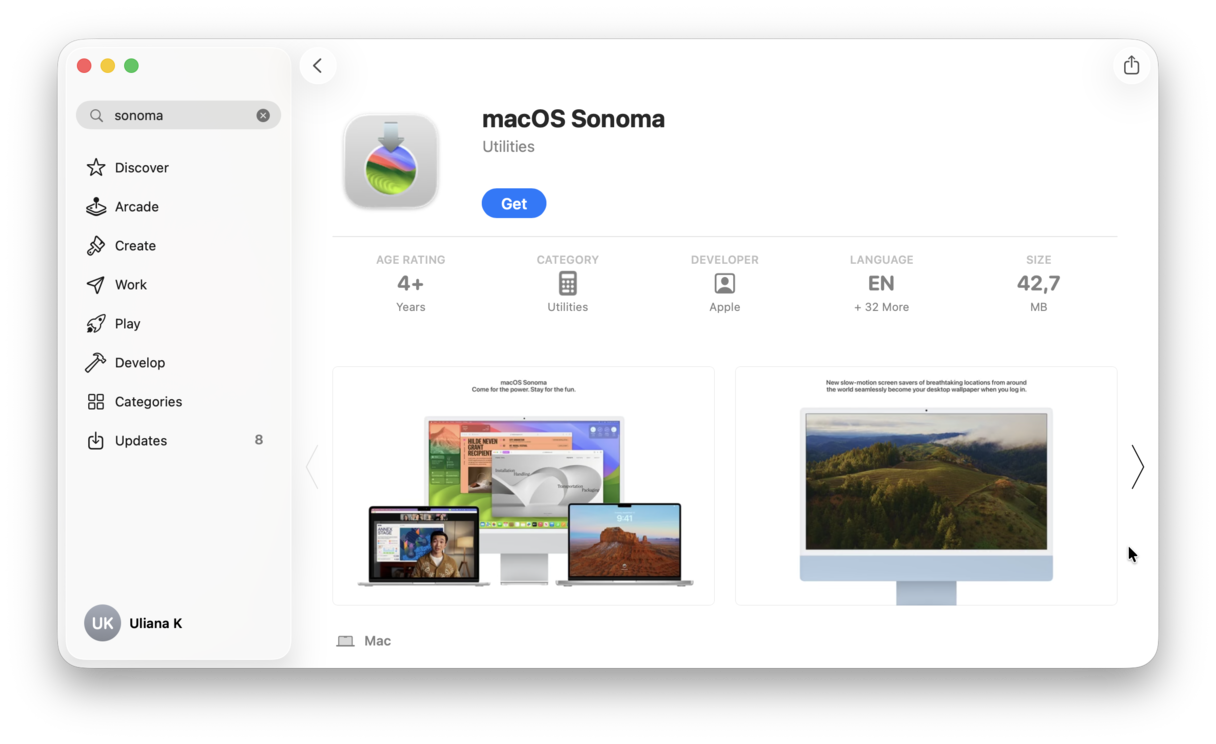
If you need an even older macOS version and you once had downloaded it from the App Store, open it and go to the Purchased tab. There, you’ll find all the installers you can download. Here is the path to check it:
- Click the App Store icon.
- Click Purchases in the top menu for old macOS versions or your name bottom left to access purchased apps.
- Scroll down to find the preferred macOS version and download it.
Without App Store: Download macOS version as Apple Developer
If you are signed up with an Apple Developer account, you can get access to products that are no longer listed on the App Store. If you desperately need a lower macOS version build, consider creating a new Developer account, among other options. The membership cost is $99/year and provides a bunch of perks unavailable to ordinary users.
Nevertheless, keep in mind that if you visit developer.apple.com/downloads, you can only find 10.3-10.6 OS X operating systems there. Newer versions are not available because starting Snow Leopard 10.7, the App Store has become the only source of updating Apple OS versions.
Check out Apple website
If you are not signed up with an Apple Developer account, you can download some old macOS versions directly from Apple. Note that it applies to older operating systems only — anything newer than High Sierra should be downloaded from the App Store following the links we provided above.
For macOS versions older than High Sierra, check out these links:
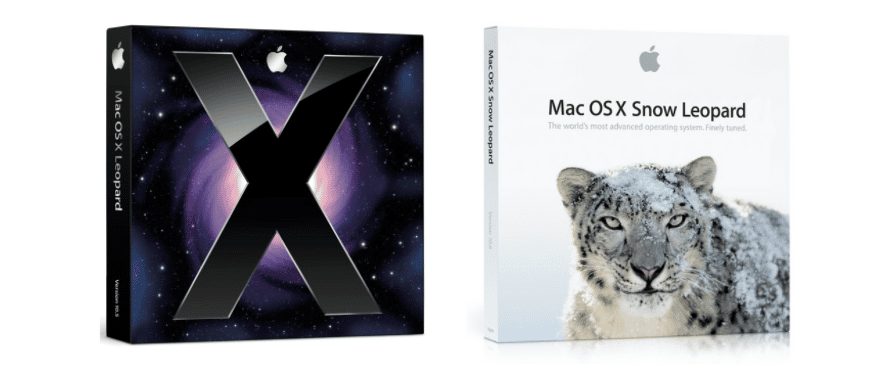
You can also pay a visit to the nearest local Apple Store. They should have image installations going back to OS Leopard and earlier. Also, you may purchase a boxed or email version of a past macOS version directly from Apple. You can ask for their assistance in creating a bootable USB drive with the installation file, too.
Terminal
Another way to download old macOS is to run a command in Terminal. However, this way, you can install only macOS versions no earlier than the version that came with your Mac or the closest still available version.
Run this command:
softwareupdate --fetch-full-installer --full-installer-version [number]
For example, softwareupdate --fetch-full-installer --full-installer-version 15.7.4 to install macOS version 15.7.4
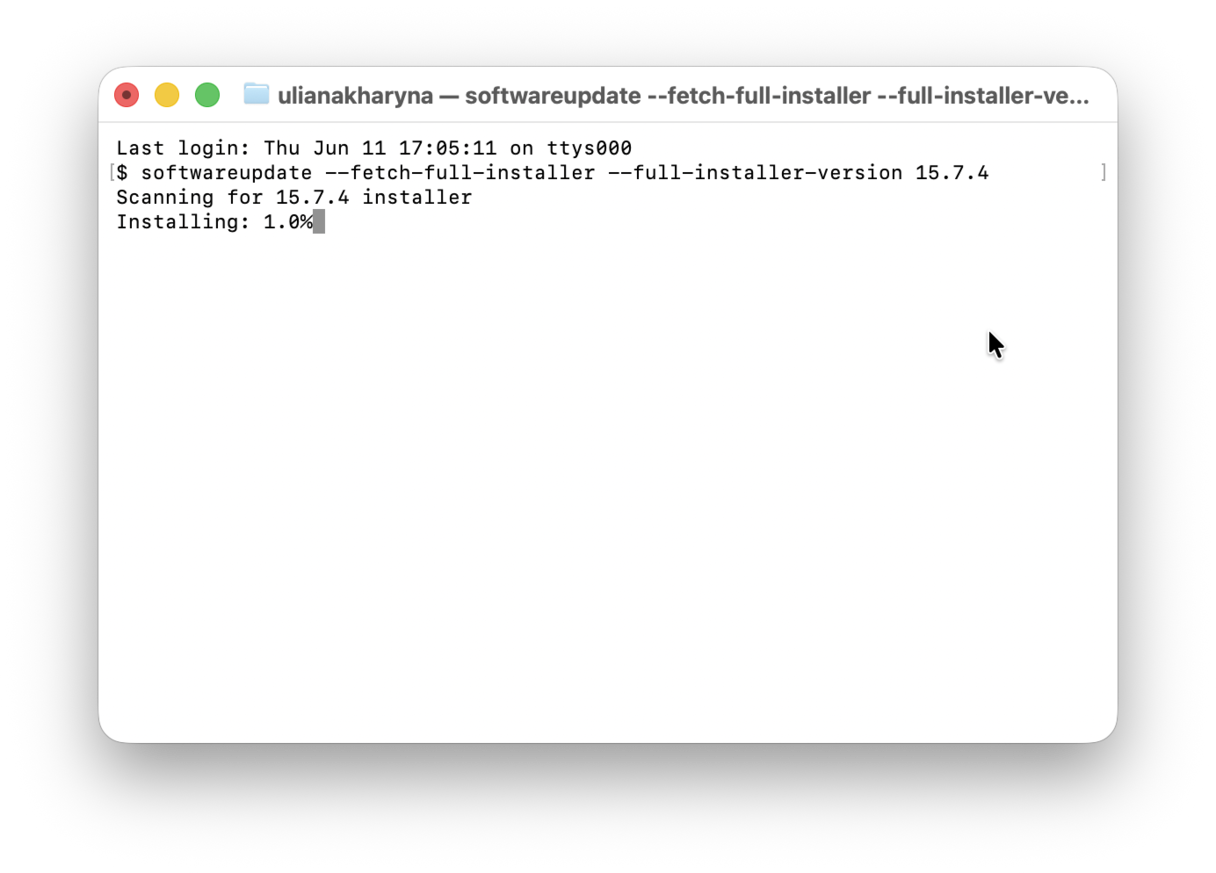
You will see the progress of the download in Terminal window and then find the installer in the Downloads folder.
Important: check compatibility
If you have a newer Mac, there is no physical option to install macOS versions older than your current Mac model. You will run into "This version of macOS cannot be installed on this computer" error message. For instance, if your MacBook was released in 2025, don’t expect it to run any OS released prior to that time because older Apple OS versions simply do not include hardware drivers for your Mac.
But as it often happens, workarounds are possible. There is still a chance to download the installation file if you have access to a Mac (or virtual machine) running that operating system. For example, to get an installer for Lion, you may ask a friend who has Lion-operated Mac or, once again, set up a virtual machine running Lion. Then, you will need to prepare an external drive to download the installation file using OS X Utilities.
Step 3. Install a macOS version
After you’ve completed the download, the installer should open automatically, but you can click Cancel and copy the file you need. You can also create a bootable installer if you want to install macOS version from an external drive or if you want to install this macOS on different Macs without having to download the installer every time.
To learn more, check out this guide from Apple Support on how to create a bootable installer for macOS. It contains all the steps and Terminal commands for each macOS version.
Note: It is for pro users only.
How to downgrade macOS versions
If your Mac runs macOS High Sierra 10.13 or later, it is possible to revert to the previous system if you are not satisfied with the experience. You can do it either with Time Machine or by creating a bootable USB or external drive.
Instruction to downgrade from macOS High Sierra
Instruction to downgrade from macOS Mojave
Instruction to downgrade from macOS Catalina
Instruction to downgrade from macOS Big Sur
Instruction to downgrade from macOS Monterey
Instruction to downgrade from macOS Ventura
Instruction to downgrade from macOS Sonoma
Instruction to downgrade from macOS Tahoe
Instruction to downgrade from macOS Golden Gate
Before you do it, the best advice is to back up your Mac so your most important files stay intact. In addition to that, it makes sense to clean up your Mac from old system junk files and application leftovers. The easiest way to do it is to run CleanMyMac on your computer (get your free CleanMyMac trial).
Key takeaways
- Prerequisites for downloading a macOS installer and running it: back up your MacBook, free up space (have at least 15% of the overall capacity free), and check compatibility
- Acquisition options: direct download from the App Store or the Apple Support website, Apple developer, or purchasing a DVD/email version of older macOS
- Installation methods: run the installer, external drive, bootable installer
Frequently asked questions
My Mac is too old to run the latest macOS — what is the newest version I can install on my specific model?
The easiest way to find it out is to check the Software Update section in System Settings. If there is no update available after the release of a new macOS version, your Mac is no longer compatible. You can also check the compatibility guide in this entry from Apple Support.
Can I download old macOS versions on a Mac with Apple silicon and are there any limitations?
Here, the compatibility rule applies: you cannot download the version that is older than the one your Mac was shipped with. The oldest macOS version compatible with Apple Silicon is macOS Big Sur. Catalina and earlier are Intel-only.
How do I downgrade macOS after upgrading?
You can restore your MacBook from a Time Machine backup, from recovery mode, or with a bootable installer. Check the links to our guides for specific macOS versions earlier in the article.